 the logical part
| A Logical Show | | Nascence of Logic | Syllogisms | Science of Logic | Logical Truth | Historical Truth | |
The forms of logical reasoning studied by Aristotle are
called syllogisms. A contemporary description of them can be read
in my paper included in the logical part
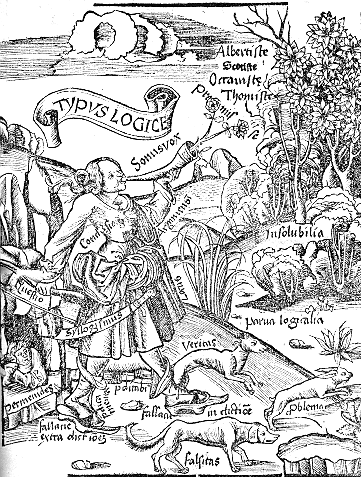
Barbara, Celarent, Darii, Ferio-que, prioris;For better understanding and remembering the logical apparatus, many allegoric composition with mnemonic rôle have been invented. We may only be amazed at the adroitness of the mediaeval authors to "draw" so abstract constructions! The illustration presented bellow is an example. It was obtained with the kind help of Prof. Karl Höltgen and the Universitätsbibliothek, Erlangen. Prof. Höltgen's deep paper on the iconography of logic contains a lot of interesting images with their interpretation. Our elucidation follows his commentation.
Cesare, Camestres, Festino, Baroco, secundae;
Tertia, Darapti, Disamis, Datisi, Felapton, Bocardo, Ferison, habet;
Quarta insuper addit Bramantip, Camenes, Dimaris, Fesapo, Fresison.
 Typus
Logice (the "Picture of Logic") is a woodcut published in the 1517
edition of Gregor Reisch's Margarita philosophica, a popular
textbook on mediaeval science. In fact, it is an encyclopaedia of the Seven
Liberal Arts and Logica is one of them. Dame Logica is represented
as a huntress chasing the hare Problema in the company of her retriever
dogs Veritas and Falsitas. She is bravely pacing bypassing
the Sylua opinionum (the "forest of opinions"; the label does not
appear in this version of the woodcut) as well as the covert of the Insolubilia
("insoluble problems"). The trees are named after four famous scholastic
philosophers: Albertus Magnus, Duns Scotus, William Occam, and Thomas Aquinas.
Some troubles can be met by her way: bushes Parua logicalia ("elementary
logical matters") and stones Fallacie but she is striding them.
The buxom huntress lustily blows her horn Sonus vox ("spoken word"),
from which two
Premisse in the shape of two roses emerge. Dame Logica's
dress and equipment include the stomacher Conclusions, the bow Questio,
the hunting-knufe Syllogismus, and the quiver Locus from
which arrows Argumenta are pricking up. Even her boots have been
named after logical notions: Predicamenta and Predicabilia.
It is remarkable that Veritas, the nimble retriever, is almost caught
up the hare, while Falsitas is lazy and standing idly by.
Typus
Logice (the "Picture of Logic") is a woodcut published in the 1517
edition of Gregor Reisch's Margarita philosophica, a popular
textbook on mediaeval science. In fact, it is an encyclopaedia of the Seven
Liberal Arts and Logica is one of them. Dame Logica is represented
as a huntress chasing the hare Problema in the company of her retriever
dogs Veritas and Falsitas. She is bravely pacing bypassing
the Sylua opinionum (the "forest of opinions"; the label does not
appear in this version of the woodcut) as well as the covert of the Insolubilia
("insoluble problems"). The trees are named after four famous scholastic
philosophers: Albertus Magnus, Duns Scotus, William Occam, and Thomas Aquinas.
Some troubles can be met by her way: bushes Parua logicalia ("elementary
logical matters") and stones Fallacie but she is striding them.
The buxom huntress lustily blows her horn Sonus vox ("spoken word"),
from which two
Premisse in the shape of two roses emerge. Dame Logica's
dress and equipment include the stomacher Conclusions, the bow Questio,
the hunting-knufe Syllogismus, and the quiver Locus from
which arrows Argumenta are pricking up. Even her boots have been
named after logical notions: Predicamenta and Predicabilia.
It is remarkable that Veritas, the nimble retriever, is almost caught
up the hare, while Falsitas is lazy and standing idly by.
 In
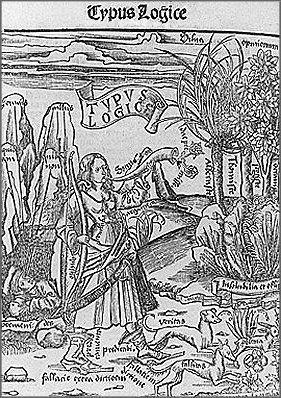
the 1508 edition of Margarita philosophica, one can see the
label Sylua opinionum, some other labels are relocated, etc. (Sorry
for the bad reproduction!) However, there is an important element which
had disappeared in later editions: the mountain summits behind the huntress.
They have been marked with the 4 syllogistic terms: Omnia ("all"),
Quidam
("some"), Nullus ("nobody"), and Quidam non ("some
not"). The man contemplating those four summits is the ancient philosopher
Parmenides who, according to the legend, spent his life on a rock in building
a system of logic. Another remarkable difference: both dogs are equally
energetic and this fact may be noted as a defect. However, taking in account
the sharp ears and the hirsute brush of Falsitas, one may conclude
that it is a wolf or a fox simulating Veritas. Indeed, that is the
central function of the falsehood, isn't it?
In
the 1508 edition of Margarita philosophica, one can see the
label Sylua opinionum, some other labels are relocated, etc. (Sorry
for the bad reproduction!) However, there is an important element which
had disappeared in later editions: the mountain summits behind the huntress.
They have been marked with the 4 syllogistic terms: Omnia ("all"),
Quidam
("some"), Nullus ("nobody"), and Quidam non ("some
not"). The man contemplating those four summits is the ancient philosopher
Parmenides who, according to the legend, spent his life on a rock in building
a system of logic. Another remarkable difference: both dogs are equally
energetic and this fact may be noted as a defect. However, taking in account
the sharp ears and the hirsute brush of Falsitas, one may conclude
that it is a wolf or a fox simulating Veritas. Indeed, that is the
central function of the falsehood, isn't it?
 It
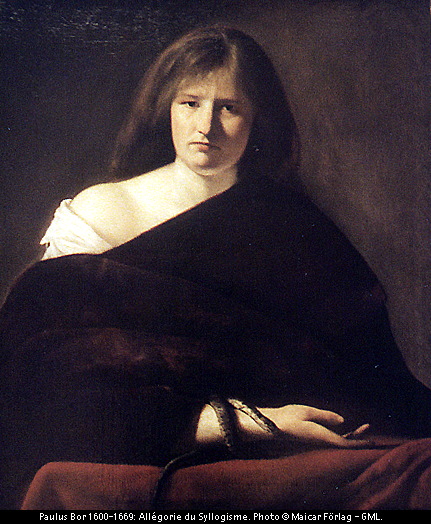
is surprising how complicated logical tools find their artistic embodiment.
Even syllogisms have been personalized! The canvas by Paulus Bor (1600-1669)
is entitled Allégorie du Syllogisme (Musée
des beaux arts, Rouen). The image has been borrowed from the Web-site of
Carlos
Parada devoted to Greek mythology. A serpent is seen twined round the
girl arm. Why it is just the reptile Bible has stigmatized as the most
perfidious and maleficent for the mankind? The answer is given in the Bible
again. The serpent is as perfidious as clever and sage: "Now the serpent
was more subtle than any beast of the field which Jehovah God had made"
(Genesis, 3:1); "Be ye therefore wise as serpents, and harmless
as doves" (Matthew, 10:16). In addition, the artist might connected
serpent's zigzag motions with the impression of syllogism as tacking between
true and false conclusions.
It
is surprising how complicated logical tools find their artistic embodiment.
Even syllogisms have been personalized! The canvas by Paulus Bor (1600-1669)
is entitled Allégorie du Syllogisme (Musée
des beaux arts, Rouen). The image has been borrowed from the Web-site of
Carlos
Parada devoted to Greek mythology. A serpent is seen twined round the
girl arm. Why it is just the reptile Bible has stigmatized as the most
perfidious and maleficent for the mankind? The answer is given in the Bible
again. The serpent is as perfidious as clever and sage: "Now the serpent
was more subtle than any beast of the field which Jehovah God had made"
(Genesis, 3:1); "Be ye therefore wise as serpents, and harmless
as doves" (Matthew, 10:16). In addition, the artist might connected
serpent's zigzag motions with the impression of syllogism as tacking between
true and false conclusions.
| A Logical Show | | Nascence of Logic | Syllogisms | Science of Logic | Logical Truth | Historical Truth | |